


- Overview
Applied Strategy and Analysis Credential (ASAC)
Overview
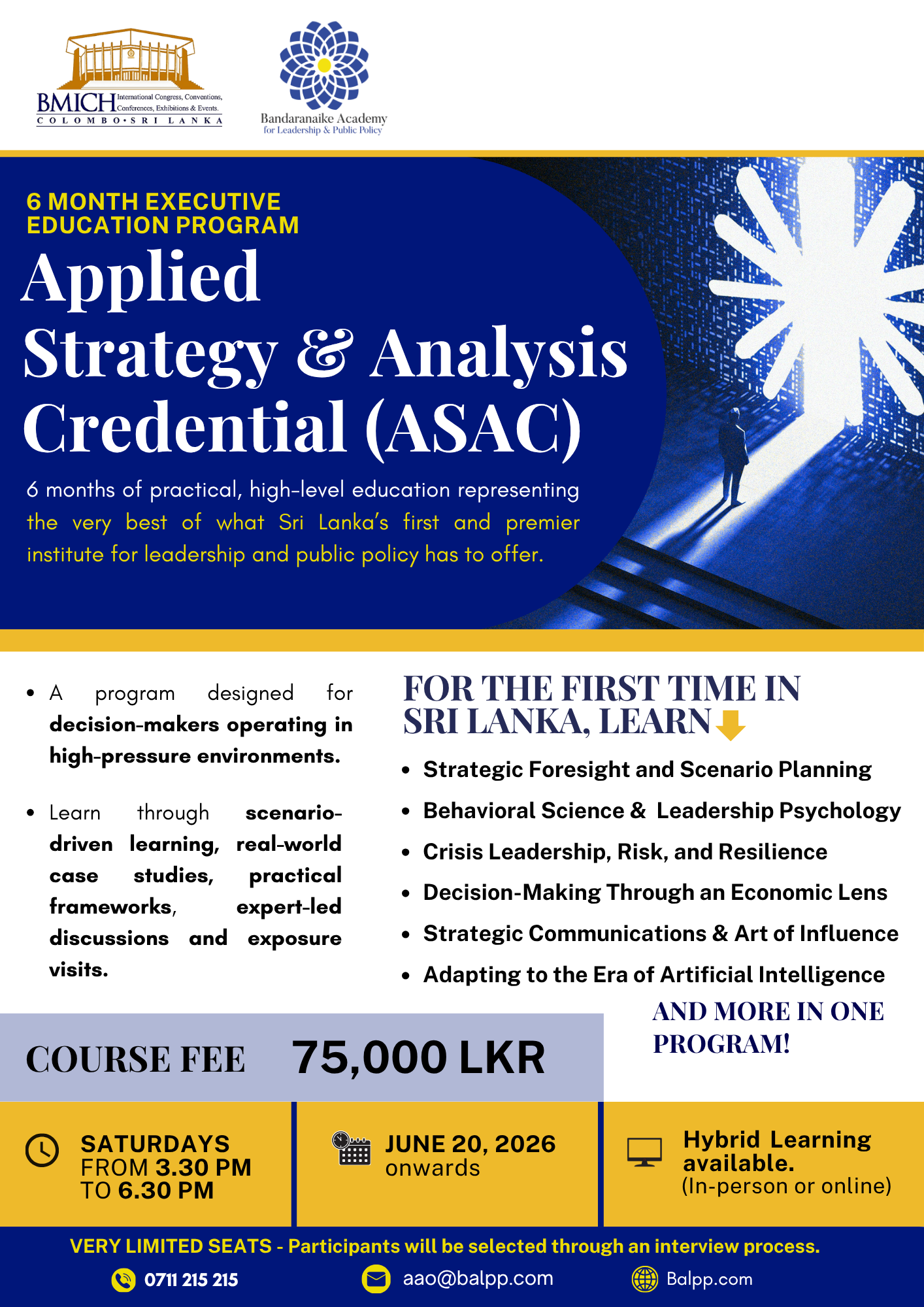
The Applied Strategy and Analysis Credential (ASAC) is a 24-week executive education programme by the Bandaranaike Academy for Leadership and Public Policy (BALPP), designed for professionals operating in complex, high-stakes environments.
Across public institutions, private enterprises, and civil society, leaders are required to make decisions under pressure while managing uncertainty, competing interests, and rapidly evolving technological and geopolitical conditions. ASAC responds to this reality by bringing together, within a single programme, the frameworks, tools, and analytical depth required to navigate complexity and deliver sustained performance.
The programme integrates insights from behavioral science, strategy, economics, communication, governance, and artificial intelligence, combining theoretical grounding with practical application. Participants develop the ability to think critically, act decisively, and communicate effectively, supported by Sri Lankan, regional, and global case studies that ensure immediate relevance to their professional contexts.
What Distinguishes ASAC
ASAC is designed specifically for leaders working within institutional and governance environments. It offers:
- Strategic foresight and scenario planning capabilities
- Integration of ethics, public policy, and AI into decision-making
- Scenario-driven, action-based learning rather than lecture-heavy delivery
- Cross-sector perspectives spanning public, private, and development sectors
- Strong contextual grounding in Sri Lanka alongside global benchmarks
The programme is structured as a leadership performance upgrade for individuals responsible for outcomes in complex systems.
Programme Structure
- Duration: 24 weeks
- Start Date: June 2026 (3rd week)
- Modules: 10 modules delivered over 20 instructional weeks
- Sessions: Weekly (Saturdays, 3.30 PM – 6.30 PM)
- Format: Hybrid (in-person and online participation)
- Session Length: 3–4 hours
The programme also includes curated exposure visits aligned with course themes, offering participants direct engagement with key institutions.
Learning Experience
ASAC adopts a highly interactive and applied learning model. Sessions are designed around real-world scenarios, requiring participants to engage with complex problems, make decisions, and defend their reasoning.
Learning is reinforced through:
- Case-based discussions
- Peer learning and collaborative problem-solving
- Exposure to real institutional environments
- Engagement with experienced practitioners and subject-matter experts
Module Outline
The programme consists of ten modules:
- Behavioral Studies and Psychology of Leadership
- Strategic Foresight and Scenario Planning
- Strategic Communications and the Art of Influence
- Evidence, Data, and Information Analysis for Decision-Makers
- Crisis Leadership, Risk, and Resilience
- Negotiation and Stakeholder Management
- Decision-Making Through an Economic Lens
- Ethics and Effective Decision-Making
- Adapting to the Era of Artificial Intelligence
- Policy Design and Governance
Who Should Apply
ASAC is designed for professionals who are responsible for decision-making and leadership across sectors, including:
- Public sector officials and civil service leaders
- Corporate managers and private sector professionals
- Political and policy staff
- Development sector practitioners
- Entrepreneurs and founders
Applicants are required to submit a CV and complete a registration process. Selection is based on suitability and readiness for the programme.
Certification Requirements
To be awarded the ASAC, participants must:
- Maintain a minimum of 60% attendance
- Successfully complete all assessment components
- Adhere to BALPP’s code of conduct